Controlled evaluation
Semantics, layout, and answers are fixed across ten languages, making language the controlled variable.
EMNLP 2026 Main Conference · Accepted
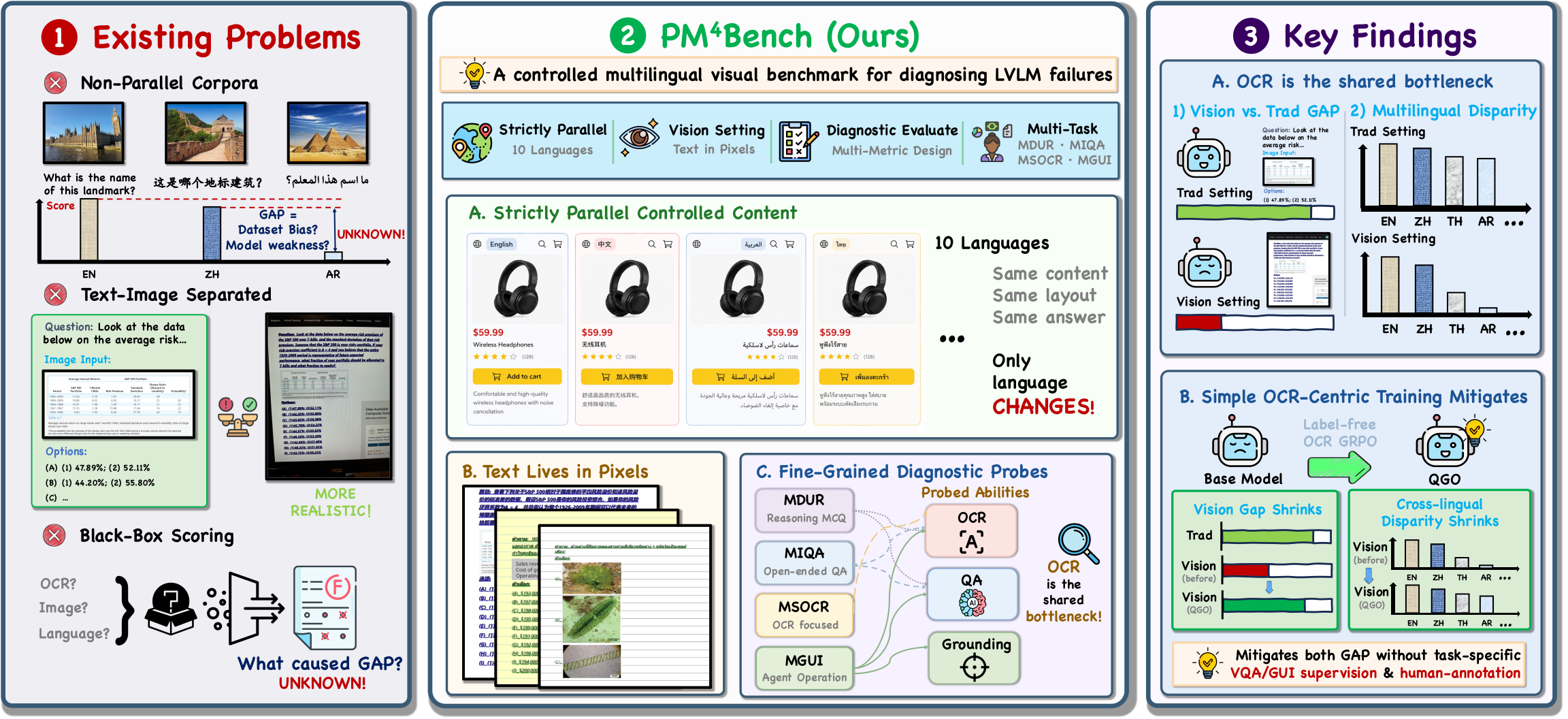
PM4Bench supports controlled evaluation across ten languages. The experiments identify OCR as a key source of cross-lingual performance gaps and motivate an OCR-centric reinforcement-learning method.
Shanghai Artificial Intelligence Laboratory · Shanghai Jiao Tong University · National University of Singapore · Tsinghua SIGS
Paper overview
Evaluating the multilingual capabilities of Large Vision-Language
Models (LVLMs) remains challenging because most benchmarks rely on
non-parallel corpora, making it unclear whether cross-lingual
performance gaps reflect model limitations or dataset inconsistencies.
We introduce PM4Bench, a multimodal, multilingual,
multi-task benchmark built on a strictly parallel 10-language corpus,
enabling fair, apples-to-apples cross-lingual comparison. We further
introduce a vision setting that embeds textual inputs
directly into images, approximating deployment scenarios where
LVLM-driven agents observe unified visual environments. Experiments
with 10 LVLMs identify OCR as a key factor behind cross-lingual
disparity. Motivated by this finding, we design an OCR-centric GRPO
strategy using fully synthesized, label-free OCR data and no costly
task-specific VQA supervision. The resulting model improves general
multilingual VQA, reduces disparity under vision, and
transfers gains beyond PM4Bench.
Main contributions
Semantics, layout, and answers are fixed across ten languages, making language the controlled variable.
Interleaved input is compared with text rendered into pixels, followed by controlled OCR analyses.
Synthetic OCR data and a dual reward improve recognition while preserving reasoning behavior.
PM⁴Bench
Every language receives the same underlying content. PM4Bench preserves meaningful script-level differences while removing the corpus mismatch that normally confounds multilingual comparisons.
traditional settingQuestions remain text and visual evidence remains image input—the standard interleaved LVLM formulation.
vision settingAll task information is rendered into one image, matching how multimodal agents perceive interfaces and environments.
MDUR
1,730 college-level multimodal reasoning cases per language.
MIQA
218 open-ended questions over related images per language.
MSOCR
100 controlled recognition probes with decreasing text size per language.
MGUI
200 indirect coordinate-grounding instructions per language.
MDUR and MIQA use an LLM-and-native-speaker translation pipeline. MGUI is generated from 100 reusable interface templates, and MSOCR provides an automated, strictly parallel recognition probe.
Key finding
The two settings differ mainly in where text lives. That controlled difference is analyzed through ground-truth OCR input, per-language correlations, and an OCR-focused training intervention.
of evaluated models show higher cross-lingual variation on MDUR / MIQA under vision.
for most models when correlating per-language MSOCR with downstream task performance.
Supplying the recognized text alongside visual input raises average performance and reduces disparity.
Together, these results identify OCR as a practical target for improving multilingual LVLMs. Base-model capability remains the upper bound.
OCR-centric training
Starting from Qwen3-VL-8B-Thinking, QGO trains on 20,000 fully synthesized OCR examples. Its reward combines recognition accuracy with response-length and format constraints: pure accuracy optimization sharpens OCR but can collapse chain-of-thought, so both sides are necessary for downstream reasoning tasks.
QGO-8B improves average score on every PM4Bench task
and setting, lowers cross-lingual variation on all four
vision tasks, and concentrates gains on weaker Arabic
and Thai baselines. The intervention also transfers beyond the
benchmark: +4.7 NED on CC-OCR overall, no broad OCRBench regression
(791 vs. 789), and +0.5 average on MTVQA trained languages.
Links
The revised manuscript is available as arXiv v3. Code, benchmark data, training data, and the complete QGO-8B checkpoint are public.
Citation
If this work is useful in your research, please use the following BibTeX entry.
@misc{gao2026benchmarkingboostingmultilingualcapabilities,
      title={Benchmarking and Boosting Multilingual Capabilities of LVLMs via OCR-Centric Reinforcement Learning},
      author={Junyuan Gao and Jiahe Song and Jiang Wu and Runchuan Zhu and Guanlin Shen and Shasha Wang and Xingjian Wei and Haote Yang and Weijia Li and Bin Wang and Lijun Wu and Conghui He},
      year={2026},
      eprint={2503.18484},
      archivePrefix={arXiv},
      primaryClass={cs.CV},
      url={https://arxiv.org/abs/2503.18484v3},
}